Sunday, January 22, 2012

Turning the compost pile

Winter, or what passes for it here, has arrived. It is cold and wet, having rained hard yesterday. I am certainly glad I have already turned over the soil in the early season beds. This time of year it will take quite some time for the soil to dry out enough to turn it and we are in the time frame for planting peas. I had hoped to put mine out this weekend, but the soil is too wet. The weather forecast is for rain for two days and sun for two days, rinse and repeat for the next week or two. I'll probably put the peas in next weekend, so long as it's not raining. I can't wait for the soil to dry out or it will get too late and the peas will get tough and starchy if they ripen in the hotter temps.
 There wasn't much to do in the gardens today, but I did get on the tractor and turn the compost pile. If you are curious, this is my little tractor here.
 These are the compost bins were the whole process starts.
The pile on the left is the older one. It has the remains of the ornamental grass I cut back a few weeks back, and the bedding of the neighbors barn (seen in the background). It has already taken on a nice rich chocolate color and it was good and hot inside the pile.
 The pile on the right is fresh bedding from this week's clean out.
This is what the two finished piles look like.
The pile on the left is almost gone, maybe a yard left .  I'll be using it and the other pile to amend the summer beds with and to use as mulch on them as well. By that time the pile that is in the bins will be pretty much ready and I'll move it out here to make room in the bins for the summer.
 You can see the standing water behind the pile from yesterday's downpour.

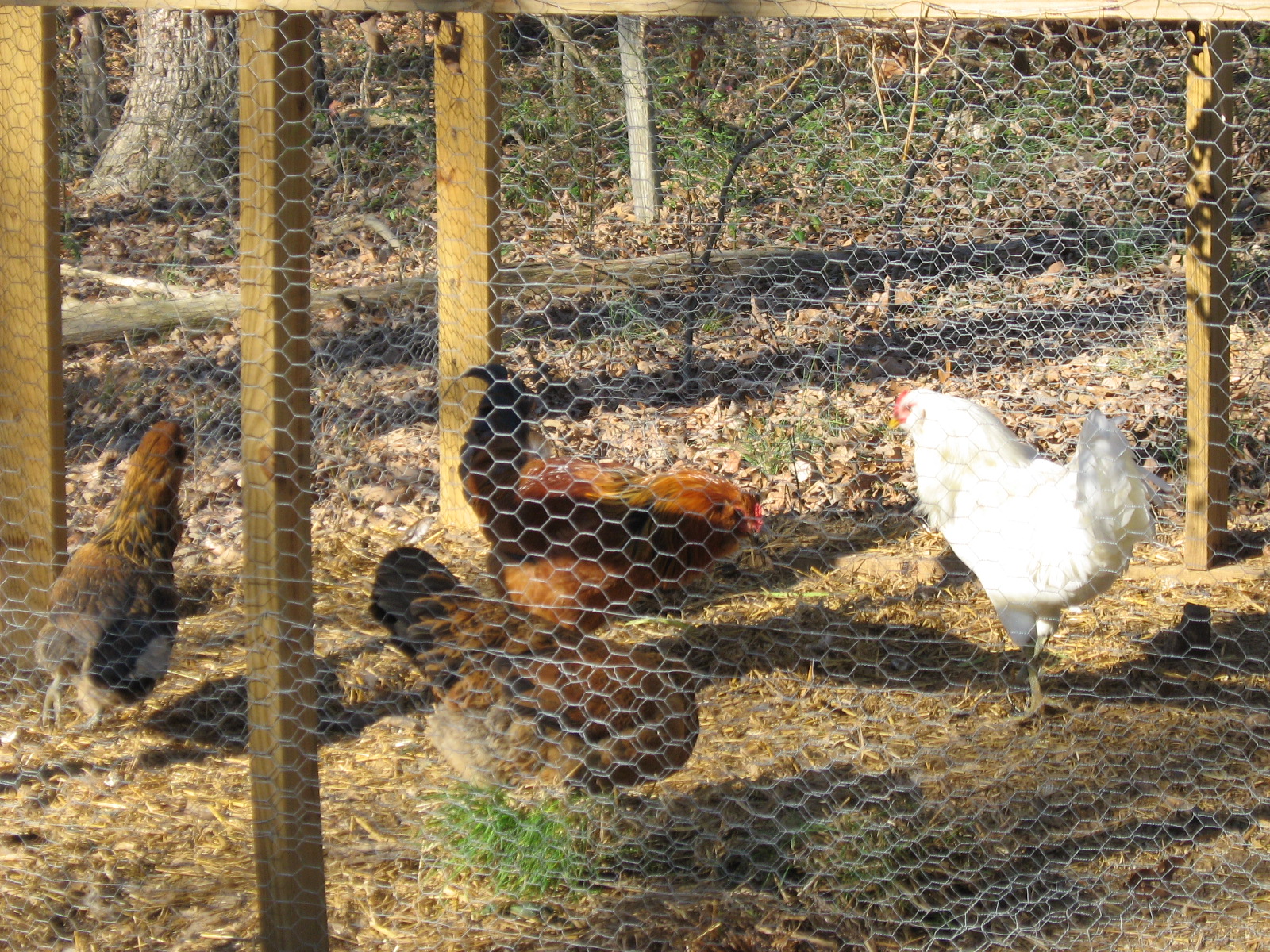
And for those who may be wondering, here are the two surviving chickens.


A view of the garlic bed.

As you can see, the garlic is doing well. We haven't had anything near a hard freeze this year, so they'll keep growing. Even a hard freeze won't do too much harm. Garlic is a pretty hardy plant.

Friday, January 13, 2012

Governor grants a pardon.

 For those of you, like my dear wife (DW) who were concerned about the two roosters' fate, they have gotten a last minute pardon from the governor (me). They will not face the executioners blade this weekend thanks to the hard work of their dedicated counsel (DW) who has found them a new home with a friend of a friend. He will be coming to pick them up tomorrow. And the best news is, he has plans to breed them with his hens. So all is well for them as they are destined for a life as studs.

Sunday, January 8, 2012

Turning under the cover crop


The top photo is the cover crop, red clover, and the second is the bed next to it which has had the clover tilled under. I will be planting the spring garden in this bed. From back to front will be potatoes, broccoli, cabbage, chinese cabbage, kholrabi, lettuce, spinach, beets and carrots. My peas will go into the 'bean' row, the one just to the right. I'll planting the potatoes in about a month, and I wanted at least that long for the clover to break down in the soil. It won't be long after that when I transplant the broccoli and cabbage that is currently growing in the seedling racks under lights. Then the seeds for the rest will go in the beds and spring will be just around the corner. By the time all that is harvested, it will be time to plant the fall crop of broccoli, cauliflower and cabbage, and some pumpkins for Halloween, and I will get a second harvest from this bed. After the pumpkins, it will back into a cover crop for the winter and the following year, this will become the 'bean bed'. The 'tomato bed' follows the next year and the last in the rotation is the 'melon bed'. 
 As you can see below, my brussel sprouts still won't form heads. I am relatively certain this will be my last attempt at growing these. While I will eat them, I am not so crazy about them that I must grow them and seeing as how I have had zero success in doing so, it is a good thing I'm not. So no more trying (and failing) for me.


This is a picture of the last of my sprouting broccoli plants. It has about a meal's worth of small sprouts on it.
These are my two hens and two roosters. Say goodbye to the roosters. Their days on this earth are limited (because my budget for chicken food is limited, as is my patience for crowing roosters).


Monday, January 2, 2012

Camelias in bloom

Just a quick post, I took some photos of a Japanese Camellia, called Mr Sam, that has been fooled into blooming by our warm temps here. This  Camellia normally blooms in late winter/early spring here. I hope that some of the buds stay dormant, and I'll get a second bloom in spring. It's going to get down into the teens tonight, so any blooms that have opening will get browned out but good tonight, so I went out and cut most of them and brought them in the house to enjoy.


Saturday, December 31, 2011

Winter pruning.

I spent some time out front of the house today. I took the electric hedge shears and cut down the variegated grass around the driveway. It went into the compost bins I share with the neighbors on the property line. They have been keeping their horses on their other property here of late and I haven't gotten my fix of stable cleanings to add to the compost piles.
 I also did some pruning on the shasta viburnums out front. They had numerous water sprouts (branches that sprout twigs that shoot straight up with no branching) and crossing branches which needed to be removed.
It's important to take some time to inspect your shrubs and trees for these types of things to keep them healthy. Water sprouts to nothing for the overall appearance of the shrub and tend to block out light and air from getting to the center of the shrub. Crossing branches can cause rubbing and bark wounds, where insects and diseases can find an easy entry point to your valued shrub.
 I also took some time to remove some Muhly Grass volunteers from my beds. I love Muhly Grass in the fall when it looks like clouds of hot pink cotton candy floating just above the ground. But it has proven to be quite invasive in my gardens. It pops up everywhere in the beds. It is definitely a love/hate type plant.

Friday, December 30, 2011

Winter doldrums.

December and January are perhaps the slowest months in my gardening year. There is not really much growing in the garden these months. Perhaps a few radish, some arugula, carrots and kale, and I am 'storing' one head of cabbage in the ground. I allowed two broccoli plants to go to flower, so as to attempt to harvest some seeds from them. The brussel sprouts don't seem to want to head up, despite the stems being covered in small starts.
 I am hoping for a dry spell for a week or more to allow the ground to dry out enough to permit me to turn under the clover. I need to turn it under at least a month prior to planting out, and it will soon be approaching time to plant the spring potato crop. This year I am limiting myself to planting just Yukon Gold and Kennebec. The Yukon Gold make superior baked potatoes and boil up nicely for potato salads. The Kennebec are good all around potatoes, useful in baking, frying and mashed, and they store longer than the Yukons. Last year I planted four seeds potatoes each of Yukon Gold, Kennebec and Pontiac Red, and was rewarded with a large paper grocery sack of each at harvest time. I am thinking this year I will plant six Yukon Gold and 12 Kennebec. I have heard it said that you should plant potatoes in newly cultivated garden spot (one that not had crops grown in it the previous four years). But I rotate mine through my garden each year. I add extra organic matter and till deeper and I do not lime the area I set aside for potatoes.
 Another thing I do in December is to plan out next year's garden. For the most part it is very similar to last year's garden, rotated one bed over. I experiment with a few different varieties of tomato each year, but my main planting of them each year is dedicated to Celebrity and Mortgage lifter. This year I plan on trying out three different types of paste tomatoes. The best of these three will become part of my regular planting scheme each year. I also try our a couple new varieties of peppers each year. The regulars of my pepper planting are Jalepeno, Habenero, Anaheim and Serano hot peppers.  My wife uses these to make her jardiniere recipe. We love it on hot dogs, and italian beef sandwiches.
 I have grown Marconi green peppers the past three years, this year I am trying California Wonder instead. Last year I grew some pepprocini peppers with the intention of canning them. I tried three different recipe/preperation methods and none of them produced an acceptable canned pepper. So this year I am going to try some Ancho peppers, that are supposed quite mild with a hint of apple flavor. Perhaps I'll make them into a jelly.

Tuesday, December 27, 2011

The beginning of a new garden year

This is my seedling rack.

This is the golden acre cabbage seedlings.

This is the Red Danish cabbage seedling.

These are spinach seedlings.

This is the iceberg lettuce seedlings.

These are some pea seedlings I'll be planting out this coming weekend.


Well it has been awhile since my last post. I have been harvesting those cool season crops which the deer, through their benevolence, have not eaten from the garden. The deer seem most enamored of my lettuce crop, but at the same time they do not seem to care for arugula. The deer have also discovered that they can charge through the deer fencing, so it seems that I shall have to erect an electric fence before spring. Fortunately the deer don't seem to care for members of the brassica family. As such I have been enjoying cabbage, broccoli, and cauliflower. However, we could not eat it all, so we froze some broccoli and cauliflower and made sauerkraut with the cabbage. We found a terrific way to prepare the cauliflower, we cut it into flowerlettes, and put it and some finely chopped garlic in a ziplock baggie with about a teaspoon of olive oil, shake it up to cover the cauliflower evenly, remove it from the baggie, then bake it in the oven at 400 for ten minutes, turn it over and bake for another ten minutes and then plate it up with a topping of parmesan cheese and salt and pepper to taste. (This works well for new potatoes as well.)
 Now that we have harvested the last of the brassica crops, it is time to start the seedlings for the spring crop. I'll be growing golden acre and red danish cabbage, along with both Atlantic and Early purple sprouting broccoli. I have also started seedlings for both Iceberg and Great Lakes lettuce. I grew both these varieties last spring and the Great Lakes was a great success but the Iceberg was brown and mushing in the middle and turning brown by the time it had formed a head. I am hoping that getting a little earlier start can have them ready before the warmer weather arrives and does it's damage to the heads. It is fortunate that I have so much space in the garden that I am allowed the luxury of using garden space to experiment with crops that really would not justify themselves in a smaller garden.  I also started two types of spinach, a hybrid (Renegade) and an open pollinated variety (Bloomsdale). I hope to have the transplants ready to go into the garden by mid February.